
India and China failed to reach any specific agreements on their disputed boundary issue on Friday in the latest round of negotiations in Beijing but decided to pursue their goal for a "fair and reasonable" solution acceptable to both sides.
In the wake of China blocking United Nations Security Council's sanctions against Jaish-e-Mohammad chief Masood Azhar, India has provided detailed information to it about his involvement in terror activities, and hopes Beijing would support the move. The issue figured during the talks between special representatives -- National Security Adviser M K Narayanan and Chinese State Councilor Dai Bingguo in New Delhi last Friday and Saturday.
Chinese State Councilor Dai Bingguo spoke to India's National Security Adviser M K Narayanan over phone and briefed him on the 'violent crimes' in Lhasa and 'expounded' China's stance on and concerns over the Tibet issue. Narayanan stated that Tibet was part of the Chinese territory and that India does not allow Tibetans to conduct 'anti-China political activities' in the country, official Xinhua news agency said.
1962 will not be allowed to happen again. Take the word of an old war veteran for it, says Colonel John Taylor (retd), even as there is talk that China may strike at India this year and try to grab some territory.
Ahead of Chinese Premier Wen Jiabao's visit to New Delhi next month, India and China will hold the 14th round of boundary talks in Beijing on November 29-30, the Chinese foreign ministry announced on Tuesday.
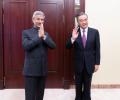
'It is advisable for Indian interlocutors to follow the Chinese tactic of repeating the Indian position, both for the record and to test the Chinese negotiator's resolve and intentions.' A riveting excerpt from former foreign secretary Vijay Gokhale's The Long Game: How the Chinese Negotiate With India.
'After more than 20 years of understanding, nothing much seems to have been achieved. What the two countries have been trying to do is to manage the recurrence of border incursions. The two sides must address the disease, and not the symptom of the disease,' says Rup Narayan Das.
